
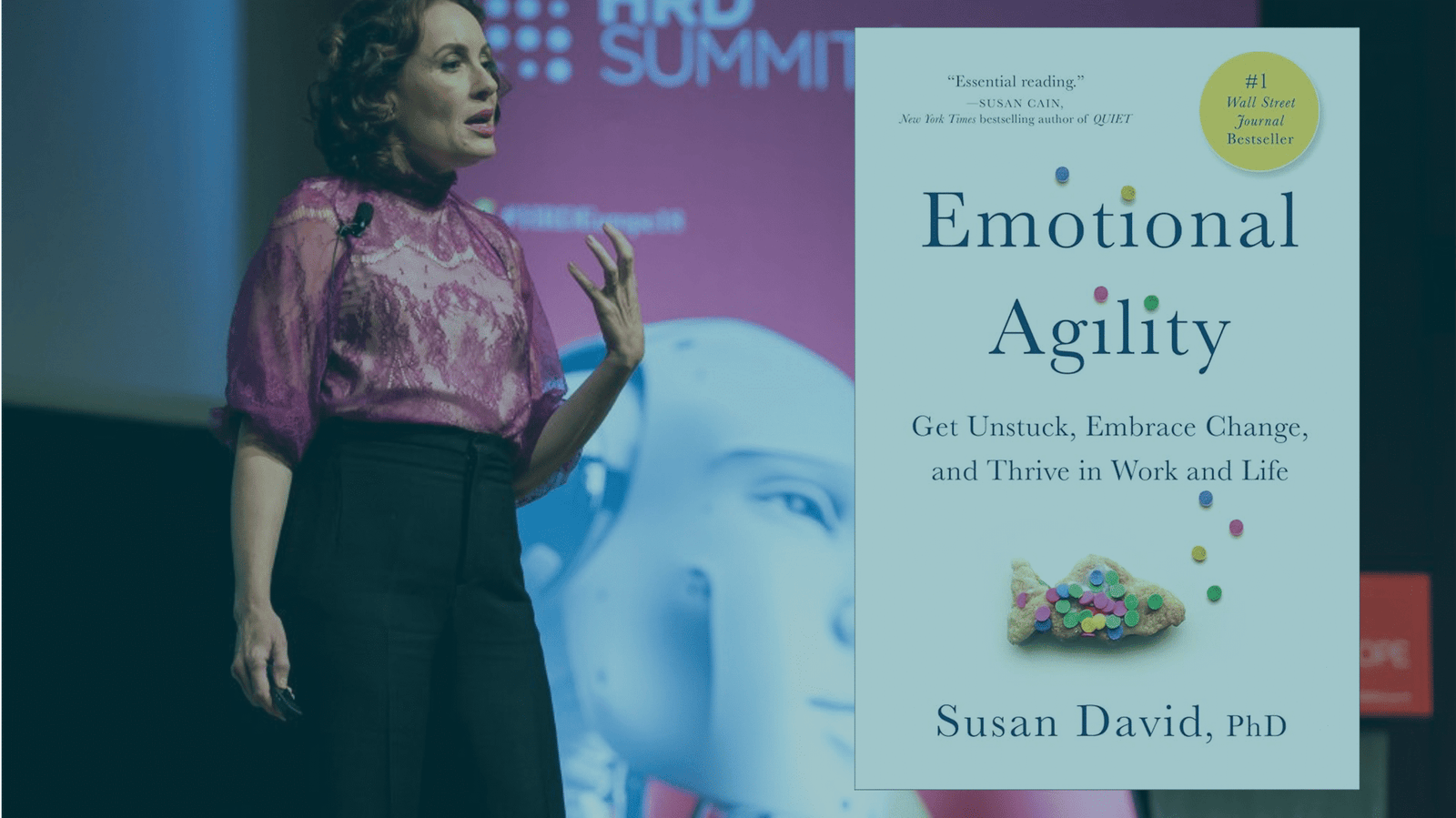

“Emotional Agility” by Susan David transforms mediocre emotional control into excellence through flexibility, resilience, and values-driven action. This practical guide shows how to unhook from rigid self-criticism and move toward empowered, intentional growth. Perfect for leaders, parents, and anyone seeking meaningful achievement, David’s research-backed framework teaches you to navigate difficult emotions without being controlled by them. Learn to show up with authenticity, step out from limiting thoughts, and walk your why with courage. Discover how small, consistent actions aligned with your values create lasting transformation and help you thrive in an unpredictable world. -flexibility-
Table of Contents
What the book covers
“Emotional Agility” by Susan David is a groundbreaking guide to navigating life’s challenges with psychological flexibility and resilience. David, a psychologist at Harvard Medical School, draws on decades of research to show that the key to thriving is not controlling or suppressing emotions, but developing the ability to engage with them in healthy, productive ways.
The book begins by challenging popular approaches to emotional wellness that emphasize positive thinking or emotional control. David argues that these strategies often backfire because they require us to fight against our natural human responses. Instead of trying to eliminate negative emotions or force ourselves to be happy, we need to develop emotional agility, which is the ability to be with our emotions in an open, curious way while still moving forward with our values and goals.
At the heart of the book is a four-step process David calls “showing up, stepping out, walking your why, and moving on.” These steps provide a practical framework for working with difficult emotions and thoughts without getting stuck in them.
The first step, “showing up,” is about facing your emotions and thoughts with acceptance and curiosity rather than judgment. David explains that many people either bottle up their emotions, pushing them down and pretending everything is fine, or brood over them, getting lost in rumination and self-pity. Both strategies keep you stuck. Showing up means acknowledging what you are feeling without immediately trying to change it or letting it define you.
David introduces the concept of “hooks,” which are the thoughts, emotions, and stories that pull us away from living according to our values. Common hooks include perfectionism, the need for control, worry about what others think, and the stories we tell ourselves about who we are and what we are capable of. These hooks feel compelling and urgent, but they often lead us away from what truly matters.
The second step, “stepping out,” is about creating space between yourself and your emotions or thoughts. David teaches readers to see their thoughts and emotions as data, not directives. Just because you think something does not make it true, and just because you feel something does not mean you have to act on it. This step involves practices like labeling your emotions with precision, noticing patterns in your thinking, and cultivating self-compassion.
One powerful technique David shares is adding the phrase “I am noticing that I am feeling…” before your emotion. Instead of saying “I am anxious,” you say “I am noticing that I am feeling anxious.” This small linguistic shift creates psychological distance and reminds you that you are not your emotions. You are the person observing and experiencing them.
The third step, “walking your why,” is about reconnecting with your core values and using them as a compass for action. David emphasizes that values are different from goals. Goals are things you achieve; values are ways of being. For example, “being a supportive friend” is a value, while “having coffee with my friend this week” is a goal that expresses that value. When you are clear on your values, you can make choices that align with what truly matters to you, even when emotions pull you in other directions.
David provides exercises to help readers identify their core values across different life domains: relationships, work, health, and personal growth. She encourages people to get specific about what each value looks like in practice. It is not enough to say you value “family.” You need to define what that means. Does it mean being present at dinner? Does it mean prioritizing weekends together? Getting clear on values makes them actionable.
The fourth step, “moving on,” is about taking small, committed actions aligned with your values, even when it is uncomfortable. David calls this “tiny tweaks,” emphasizing that transformation does not require dramatic overhauls. Small changes, practiced consistently, create lasting shifts. She also introduces the concept of the “bottleneck,” which is identifying the one area where making a change will have the biggest impact across other areas of your life.
Throughout the book, David addresses common emotional challenges like anxiety, self-doubt, perfectionism, and the pressure to be constantly positive. She shows how emotional agility applies to each of these struggles. For example, with perfectionism, emotional agility means noticing the perfectionistic thought, stepping out from it, and asking whether acting on that thought serves your values. Often, perfectionism keeps you from taking action at all, which works against values like growth or contribution.
David also explores the importance of emotional diversity. She explains that people who experience a wide range of emotions, including difficult ones, tend to be more resilient and psychologically healthy than those who try to maintain constant positivity. Emotions are information. Sadness tells you something matters. Anger signals a boundary has been crossed. Anxiety points to uncertainty. When you allow yourself to feel the full spectrum of emotions, you gather important data about your life and what needs attention.
The book includes research-backed insights, real-world stories from David’s clinical practice, and practical exercises. David writes with warmth and honesty, sharing her own struggles with emotional rigidity and how developing emotional agility transformed her life. The tone is compassionate but clear. She does not sugarcoat the difficulty of this work, but she also makes it feel accessible and achievable.
“Emotional Agility” is structured in a way that builds logically. Each chapter expands on the core framework, offering deeper insights and tools. The writing is engaging, blending science with storytelling. David uses examples from diverse contexts—parenting, leadership, personal health, relationships—showing that emotional agility is relevant to every area of life.

Why You Should Read “Emotional Agility”
- Escape overthinking and avoidance patterns
- Permission to act without positivity
- Navigate anxiety as useful information
- Emotionally agile leadership inspires trust
- Raise emotionally intelligent resilient children
- Unhook from perfectionism and people-pleasing
- Build excellence through small tweaks
- Reduce inner critic’s power effectively
- Manage emotions without being managed
- Live meaningfully aligned with values
You should read “Emotional Agility” if you feel stuck in patterns of overthinking, self-criticism, or avoidance. This book offers a practical, science-based framework for working with your inner experience in a way that supports growth and resilience. Instead of fighting against difficult emotions or trying to maintain constant positivity, you learn to navigate your emotional landscape with skill and intention.
One of the most compelling reasons to read this book is that it moves beyond the limitations of positive psychology. While positive thinking has value, it can become toxic when it dismisses or invalidates real struggles. David shows that you do not need to feel positive to act positively. You can feel anxious and still move forward. You can feel self-doubt and still take risks. Emotional agility gives you permission to be fully human while still living a values-driven life.
The book is especially valuable for anyone dealing with anxiety, stress, or uncertainty. In today’s fast-paced, unpredictable world, these emotions are common. David does not promise to eliminate them. Instead, she teaches you how to be with them skillfully. You learn to see anxiety as information rather than a stop sign. This shift is liberating. You stop waiting to feel ready or confident before acting, and you start acting in alignment with your values regardless of how you feel.
“Emotional Agility” is also essential reading for leaders and managers. David demonstrates that emotionally agile leaders create more innovative, psychologically safe, and productive teams. They model vulnerability and authenticity, which encourages others to do the same. They do not pretend to have all the answers, but they stay grounded in their values and make decisions from that foundation. If you want to lead in a way that inspires trust and brings out the best in others, this book will show you how.
Parents will find immense value in “Emotional Agility” as well. David shows how to help children develop emotional agility from a young age. Instead of dismissing children’s emotions with phrases like “you are fine” or “do not cry,” emotionally agile parents validate emotions while also teaching children that they can feel something and still make good choices. This approach raises children who are resilient, self-aware, and emotionally intelligent.
The book is also powerful for anyone struggling with perfectionism or people-pleasing. These patterns often stem from rigid beliefs about who you should be and how you should feel. Emotional agility helps you unhook from those beliefs. You learn to notice when you are acting out of fear of judgment or failure and to redirect your energy toward what truly matters. This does not mean lowering your standards. It means aligning your standards with your values rather than with external validation.
Another reason to read “Emotional Agility” is its emphasis on small, sustainable changes. David does not ask you to overhaul your entire life. She encourages tiny tweaks, which are manageable and build momentum over time. This approach is especially helpful for people who have tried and failed at big transformations. You learn that excellence is built through small, consistent actions, not dramatic leaps.
The book also addresses the inner critic, that harsh voice that tells you that you are not good enough or that you are doing it wrong. David teaches you to step out from that voice, to see it as just one thought among many, and to choose whether to listen to it. This practice is transformative. It does not silence the inner critic, but it reduces its power. You stop believing everything you think.
“Emotional Agility” is valuable for professionals in any field. Whether you are navigating workplace stress, career transitions, or difficult colleagues, the skills in this book help you stay grounded and effective. You learn to manage your emotions without being managed by them. You develop the ability to stay flexible and responsive in the face of challenges, which is the hallmark of resilience.
Finally, this book is for anyone who wants to live a more meaningful life. David shows that meaning comes from living in alignment with your values, not from achieving specific outcomes or avoiding discomfort. When you develop emotional agility, you stop being driven by fear or the need for approval. You start being guided by what truly matters to you. That shift changes everything.
What I learned from this book
“Emotional Agility” gave me a language and framework for something I had been witnessing in my coaching practice but could not fully articulate. I noticed that clients who made the most progress were not the ones who experienced the fewest challenges. They were the ones who could sit with discomfort, acknowledge their emotions, and still take action aligned with their goals. David’s book showed me that this quality, emotional agility, is both learnable and essential for growth.
One of the biggest lessons I took from the book is the concept of unhooking. Before reading “Emotional Agility,” I did not fully appreciate how often I was hooked by my own thoughts and emotions. I would have a thought like “I am not qualified to coach this person” and immediately believe it, letting it shape my behavior. David taught me to notice the hook, label it, and choose whether to follow it. Now, when that thought arises, I say to myself, “I am noticing the thought that I am not qualified.” That simple shift creates space for me to ask, “Is this thought useful? Does acting on it serve my values?” Usually, the answer is no, and I can move forward anyway.
This practice of labeling has become central to how I coach. When clients share difficult emotions, I often invite them to label what they are feeling with precision. Instead of saying “I feel bad,” we get specific: “I feel disappointed, overwhelmed, and a bit ashamed.” This specificity reduces the intensity of the emotion and gives us clarity about what needs attention. David’s research shows that emotional granularity, the ability to distinguish between nuanced emotions, is a key component of emotional health.
Another powerful lesson from the book is the distinction between values and goals. I used to help clients set ambitious goals without first clarifying their values. This approach led to achievements that felt hollow. Clients would hit their targets and then ask, “Now what?” David’s framework helped me see that goals need to be rooted in values to be truly satisfying. Now, I start every coaching engagement by exploring values. We identify what matters most to the client across different life areas, and then we set goals that express those values. This shift has made my coaching more meaningful and sustainable.
The concept of “walking your why” has also shaped my personal life. I realized I was spending a lot of energy on activities that did not align with my core values. I was saying yes to opportunities because they seemed prestigious or because I did not want to disappoint people, not because they mattered to me. David’s book gave me permission to say no. I started asking, “Does this align with my values?” If the answer was no, I declined, even when it felt uncomfortable. Over time, this practice freed up space for what truly matters.
David’s idea of “tiny tweaks” also transformed how I approach change, both for myself and for my clients. I used to think transformation required big, bold moves. But I saw that big moves often led to burnout or backsliding. Tiny tweaks, on the other hand, are sustainable. They build confidence and momentum. One client wanted to improve her physical health but felt overwhelmed by the idea of a complete lifestyle overhaul. We identified one tiny tweak: drinking a glass of water first thing every morning. That simple action created a sense of agency and led, over time, to other healthy habits. David’s framework showed me that excellence is built one small choice at a time.
The book also deepened my understanding of the relationship between emotions and values. David explains that emotions are not obstacles to living well; they are guideposts. When I feel frustrated, it often means something I value is being blocked. When I feel sad, it means I care about something I have lost or do not have. This reframe helped me stop seeing my emotions as problems to fix and start seeing them as information to learn from.
I have also used the concept of emotional agility to navigate difficult moments in my coaching practice. There are times when a client’s story triggers my own emotions or when I feel uncertain about how to help. In the past, I would try to push those feelings away or pretend they were not there. Now, I acknowledge them. I might say to myself, “I am noticing that I am feeling uncertain right now.” That acknowledgment creates space for me to stay present with the client rather than getting lost in my own reactions.
David’s emphasis on self-compassion also resonated deeply. She shows that emotional agility is not about being hard on yourself for having difficult emotions. It is about being kind to yourself while still taking responsibility for your actions. This balance is crucial. Too much self-compassion without accountability becomes indulgence. Too much accountability without self-compassion becomes harshness. Emotional agility holds both.
Finally, “Emotional Agility” reinforced my belief that transformation is not about becoming someone different. It is about becoming more fully yourself. When you develop emotional agility, you stop trying to force yourself into someone else’s idea of who you should be. You honor your own emotions, values, and experiences. From that foundation, you can build a life of excellence and meaning.
Abhisshek Om Chakravarty,
Mindset And Disrupt Coach,
International Mindset Academy,
internationalmindsetacademy.org
Hyderabad, Bharat (India).
Instagram | LinkedIn | Youtube | Facebook | X [Twitter]

Content Time Stamp:
- 19-Jan-2025: Published