
“The Happiness Trap” by Russ Harris transforms mediocre struggle with emotions into excellence through acceptance, psychological resilience, and values-driven action. This practical ACT guide reframes anxiety, self-doubt, and perfectionism as guidance rather than obstacles, offering step-by-step tools for living authentically. Perfect for anyone caught in the pursuit of constant happiness or fighting against difficult feelings, Harris shows that psychological flexibility, not positive thinking, creates meaningful change. Learn defusion techniques to observe thoughts, expansion practices to accept emotions, and values clarification to guide action. Discover how making peace with your inner experience while pursuing what matters leads to lasting transformation.
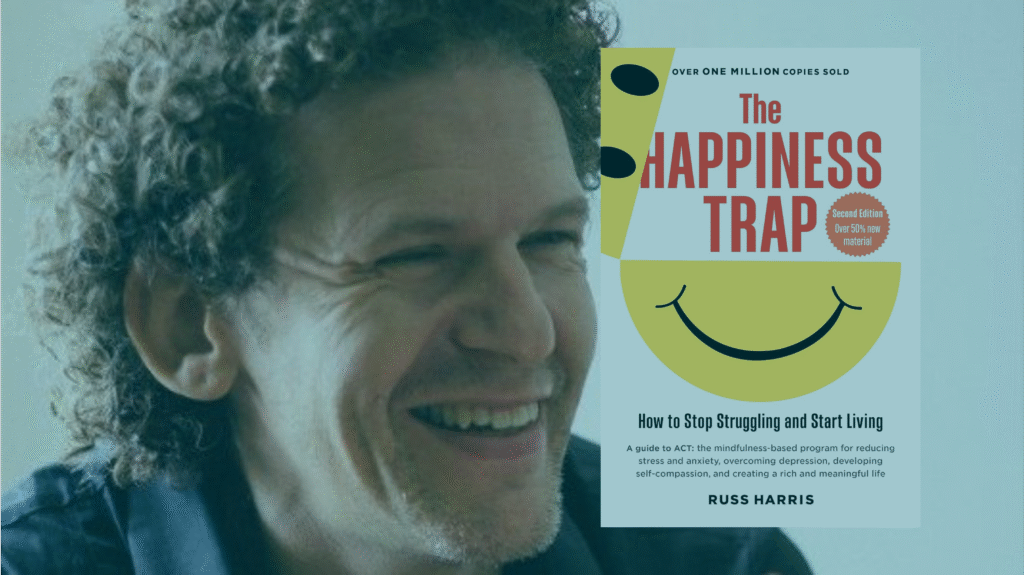
Table of Contents
What the book covers
“The Happiness Trap” by Russ Harris is a practical, transformative guide to Acceptance and Commitment Therapy (ACT), a revolutionary approach to mental health that challenges our cultural obsession with happiness and offers a more effective path to a rich, meaningful life. Harris, a medical practitioner and ACT therapist, presents complex psychological concepts in clear, accessible language, making this evidence-based therapy available to anyone struggling with anxiety, depression, stress, or the pervasive sense that something is wrong.
The book begins by identifying what Harris calls “the happiness trap,” which is the widespread belief that to live a good life, we must eliminate negative feelings and maximize positive ones. This belief creates a paradoxical trap: the more we struggle to be happy and avoid pain, the more we suffer. Harris shows that this pursuit of constant happiness is not only impossible but counterproductive. Trying to control or eliminate uncomfortable thoughts and feelings actually amplifies them, creating a cycle of struggle that keeps us stuck.
Harris introduces ACT as an alternative based on six core processes that work together to create psychological flexibility. Instead of fighting against difficult thoughts and feelings, ACT teaches you to accept them, be present with your experience, identify your values, and take committed action in the direction of what matters most to you. This approach does not promise to make you happy, but it does promise to help you live a richer, fuller, more meaningful life.
The first core process is defusion, which means learning to observe your thoughts rather than getting caught up in them or believing them automatically. Harris explains that thoughts are just words and pictures in your mind, not facts or commands. He provides numerous exercises to help readers practice defusion, such as saying “I’m having the thought that…” before negative self-talk, which creates distance between you and the thought. This simple practice can dramatically reduce the power thoughts have over you.
The second process is acceptance, which is the willingness to allow thoughts, feelings, sensations, and urges to come and go without struggling with them. Harris clarifies that acceptance does not mean liking, wanting, or approving of these experiences. It means making room for them, letting them be, and not wasting energy fighting against what you cannot control. He provides the “expansion” technique, a body-based method for accepting difficult emotions by breathing into them and allowing them to expand rather than contracting against them.
The third process is contact with the present moment, or mindfulness. Harris emphasizes that much of our suffering comes from dwelling on the past or worrying about the future. When you bring your attention to the present moment, you can engage more fully with life as it is happening. The book includes simple mindfulness exercises that anyone can practice, from noticing your breath to savoring a cup of tea to truly listening in conversations.
The fourth process is self-as-context, or the observing self. Harris explains that we are not our thoughts, feelings, or the stories we tell about ourselves. There is a part of us that can observe all these experiences without being defined by them. This perspective creates psychological flexibility because you can have difficult thoughts and feelings without letting them control your behavior.
The fifth process is values clarification. Harris guides readers to identify what truly matters to them in different life domains: relationships, work, personal growth, health, leisure. He distinguishes between values and goals. Values are ongoing directions you want to move toward, like being a loving parent or contributing to your community. Goals are specific achievements along that path. Values provide meaning and direction regardless of whether specific goals are achieved.
The sixth process is committed action, which means taking effective action guided by your values, even in the presence of difficult thoughts and feelings. Harris provides practical strategies for setting goals, overcoming obstacles, and building habits that express your values. The emphasis is on flexible persistence: you keep moving toward what matters while remaining open to adjusting your approach when circumstances change.
Throughout the book, Harris addresses common psychological struggles; anxiety, depression, low self-esteem, anger, procrastination: showing how ACT principles apply to each. He includes worksheets, exercises, and metaphors that make abstract concepts tangible. For example, he uses the metaphor of passengers on a bus: your thoughts and feelings are noisy passengers telling you where to go, but you are the driver, and you get to choose the direction based on your values, not their demands.
Harris also tackles the fear and avoidance that keep people stuck. He explains that experiential avoidance, the attempt to avoid, suppress, or get rid of unwanted thoughts and feelings, is at the root of most psychological suffering. The alternative is psychological flexibility: the ability to be present with your experience, choose valued directions, and take action even when it is difficult or uncomfortable.
The book concludes with guidance on building a sustainable ACT practice. Harris emphasizes that this is not a quick fix but a set of skills that improve with practice. He encourages readers to start small, be patient with themselves, and return to the principles whenever they notice they are caught in struggle or avoidance.

The Happiness Trap – Russ Harris | acceptance, resilience, values | Book Recommendations | International Mindset Academy
Why someone should read “The Happiness Trap – Russ Harris”
You should read “The Happiness Trap” if you struggle with anxiety, self-doubt, perfectionism, or the exhausting pursuit of positive thinking while trying to eliminate negative emotions. This book offers a radically different approach that is both evidence-based and immediately practical. Instead of fighting against your inner experience, you learn to make peace with it while building a life aligned with your deepest values.
One of the most compelling reasons to read this book is that it normalizes struggle. Harris shows that painful thoughts and feelings are not signs that something is wrong with you; they are normal parts of being human. The human mind naturally produces negative thoughts, compares, worries, and judges. Trying to eliminate this is like trying to stop the ocean from producing waves. The solution is not to calm the ocean but to learn to surf. This reframe alone can relieve enormous guilt and shame.
The book is especially valuable for anyone who has tried positive thinking, affirmations, or cognitive restructuring and found them insufficient. Harris explains why these approaches often fail: they are based on the assumption that you must change your thoughts before you can change your life. ACT offers an alternative: you do not need to think differently to act differently. You can have anxious thoughts and still move toward what matters. You can feel inadequate and still try. This is liberating for people who have been waiting to feel confident or motivated before taking action.
“The Happiness Trap” is essential reading for anyone dealing with anxiety. Harris reframes anxiety not as a problem to solve but as a signal to pay attention to. When you stop fighting anxiety and start accepting it as information, it loses much of its power. The expansion technique alone has helped countless people reduce the intensity and duration of panic attacks, not by making anxiety go away but by changing their relationship to it.
The book is also powerful for perfectionists. Harris shows that perfectionism is a form of experiential avoidance, you try to be perfect to avoid the discomfort of failure, criticism, or not being enough. But this avoidance keeps you stuck. ACT teaches you to accept that you will make mistakes, that others will judge you, that you will sometimes fail, and to act according to your values anyway. This shift from avoiding discomfort to pursuing meaning is transformative.
For anyone feeling stuck or directionless, the values clarification exercises in this book are invaluable. Many people go through life pursuing goals they think they should want rather than values that actually matter to them. Harris helps you identify what is truly important to you, not what your parents, society, or your inner critic says should be important. This clarity provides a compass for decision-making and a source of motivation that external goals cannot match.
The book is valuable for people in helping professions—therapists, coaches, teachers, clergy. ACT provides a framework that complements other therapeutic approaches and can be integrated into various settings. Understanding ACT helps professionals guide clients more effectively, recognizing when clients are caught in struggle and helping them shift to acceptance and valued action.
“The Happiness Trap” is also practical for anyone interested in mindfulness but intimidated by traditional meditation instruction. Harris presents mindfulness not as a spiritual practice requiring years of dedication but as a practical skill for being present with your life. The exercises are simple, brief, and immediately applicable. You do not need to sit on a cushion for hours; you can practice mindfulness while washing dishes, walking, or having a conversation.
The book is relevant for parents who want to teach their children emotional resilience. Harris’s approach models how to acknowledge difficult feelings without being controlled by them, how to choose actions based on values rather than impulses, and how to persist in the face of obstacles. These are life skills that benefit people of all ages.
Another reason to read “The Happiness Trap” is its practical approach to goal-setting and behavior change. Harris shows that motivation follows action, not the other way around. You do not wait to feel motivated; you act according to your values, and motivation often emerges from the doing. This insight helps people overcome procrastination and build momentum even when they do not feel ready.
The book is also powerful for understanding the relationship between thoughts and reality. Harris uses the metaphor of thoughts as leaves floating down a stream. You can watch them drift by, or you can jump in and get swept away. When you learn to observe thoughts without automatically believing or obeying them, you gain tremendous freedom. This skill is particularly valuable for people caught in rumination, worry, or harsh self-criticism.
“The Happiness Trap” connects directly to the theme of moving from mediocre to excellence. Mediocre is what happens when you let fear, self-doubt, and the pursuit of comfort dictate your choices. Excellence emerges when you identify what truly matters and commit to it regardless of discomfort. ACT provides the tools for this shift, helping you unhook from limiting thoughts, accept difficult emotions, and take action aligned with your values.
Finally, this book is for anyone tired of the self-help industry’s promise that you can think your way to happiness. Harris offers something more honest and sustainable: you can build a meaningful life even when you are not happy, even when you are struggling, even when your mind is telling you that you are not good enough. This message is both realistic and profoundly hopeful.
The Happiness Trap – Russ Harris | acceptance, resilience, values | Book Recommendations | International Mindset Academy
What I learned from this book:
“The Happiness Trap” fundamentally changed how I understand suffering and how I coach people through it. Before reading this book, I believed that reducing painful thoughts and feelings was a necessary step toward change. I would help clients challenge negative thoughts, reframe beliefs, and cultivate positive emotions. While these approaches had value, I noticed they often created more struggle. Clients would feel guilty for having negative thoughts or anxious about their anxiety, creating additional layers of suffering.
Harris showed me that the problem is not the thoughts and feelings themselves but the struggle against them. This insight was revolutionary. I started teaching clients defusion techniques, helping them observe their thoughts rather than believe them automatically. One simple practice; saying “I notice I’m having the thought that I’m not good enough” instead of “I’m not good enough” created immediate relief. Clients could see their thoughts as mental events rather than facts, which reduced their power.
The concept of experiential avoidance also transformed my coaching. I realized that many patterns clients struggled with: procrastination, perfectionism, people-pleasing, workaholism, were forms of avoiding uncomfortable internal experiences. When I helped clients see this, we could address the real issue: not the external behavior but the internal avoidance driving it. This deeper work created more lasting change.
The expansion technique became one of my most frequently used tools. When clients described feeling overwhelmed by anxiety, sadness, or anger, I would guide them through expansion: noticing where they felt the emotion in their body, breathing into it, making space for it. This practice often brought immediate calm, not because the emotion disappeared but because they stopped fighting it. Over time, clients learned they could handle difficult emotions, which built confidence and resilience.
Harris’s emphasis on values clarification also reshaped my coaching process. I used to help clients set goals without first exploring their values. This often led to achievement without satisfaction. Now, I always start with values work: What matters to you? What kind of person do you want to be? What do you want your life to stand for? These questions create a foundation for goal-setting that is meaningful and motivating. When clients pursue goals aligned with their values, they experience fulfillment regardless of outcomes.
The distinction between values and goals was particularly powerful. Values are ongoing directions; goals are milestones along the path. This helped clients stop tying their worth to specific achievements and start finding meaning in the ongoing process of living according to their values. One client who had been devastated by a failed business realized that her value was entrepreneurship and creativity, not any particular venture. This reframe allowed her to move forward with resilience rather than defeat.
Harris’s teaching that you do not need to feel confident to act confidently changed how I approach fear and self-doubt. I stopped trying to help clients feel better before taking action and started helping them act according to their values while feeling afraid. This shift accelerated progress dramatically. Clients stopped waiting for perfect conditions or perfect feelings and started moving forward despite discomfort.
The book also influenced my personal life. I noticed I had been caught in the happiness trap, believing that I should feel positive and motivated most of the time and that negative emotions were problems to solve. ACT gave me permission to feel the full range of human emotions without judgment. When I felt anxious, sad, or frustrated, I stopped asking, “What’s wrong with me?” and started asking, “What does this tell me about what matters?” This shift from pathologizing emotions to using them as data made me more resilient and self-compassionate.
Harris’s metaphor of passengers on a bus helped me understand my relationship with intrusive thoughts. My mind produces thoughts like “You’re not qualified,” “This won’t work,” “You’re going to fail.” Instead of arguing with these thoughts or trying to replace them with positive ones, I learned to acknowledge them as noisy passengers while I, the driver, chose the direction based on my values. This practice reduced the power of self-doubt and allowed me to keep moving forward.
The mindfulness exercises in the book also became part of my daily practice. I had tried meditation before but found it difficult and felt like I was failing. Harris’s approach to mindfulness was more accessible: simply noticing your experience in the present moment without judgment. I started practicing mindfulness during everyday activities: eating, walking, listening, and found it both easier and more beneficial than formal meditation.
The book’s emphasis on committed action reminded me that insight alone does not create change. Many clients had profound realizations in sessions but did not follow through with action. ACT helped me see that my role was not just to facilitate insight but to support committed action aligned with values. I started ending sessions with specific commitments and accountability structures, which dramatically improved client outcomes.
Harris’s discussion of barriers and obstacles also shaped my approach. He acknowledges that taking valued action is difficult and that obstacles are inevitable. Instead of seeing obstacles as failures, we can see them as opportunities to practice flexibility, problem-solving, and persistence. This reframe helped me and my clients view setbacks as part of the process rather than evidence of inadequacy.
Finally, “The Happiness Trap” reinforced my belief that excellence is not about eliminating struggle but about moving toward what matters despite struggle. The clients who made the most significant progress were not those who felt the best but those who were willing to feel uncomfortable in service of their values. This is the essence of psychological flexibility and the foundation of a meaningful life.
Abhisshek Om Chakravarty,
Mindset And Disrupt Coach,
International Mindset Academy,
internationalmindsetacademy.org
Hyderabad, Bharat (India).
Instagram | LinkedIn | Youtube | Facebook | X [Twitter]

Content Time Stamp:
- 2-June-2024 Published
The Happiness Trap – Russ Harris | acceptance, resilience, values | Book Recommendations | International Mindset Academy